Tuesday, December 18, 2012

CCSS1 Unit 9: Ancient Egypt


Unit 9 Part 4: Egypt: Natural Environment and History p.146
4.1 The Natural Environment
Egypt = -big desert w/ Nile River crossing N to S
            Nile = -flows from Lake Victoria to Med. Sea
                        -big delta at mouth of river
                        -flooded once per year in Ancient times, fertilizing the banks
                        -Ppl. Worhsipped the river b/c it was a source of life + main transport route
            LOWER Egypt = North: delta= flat, marshy area
            UPPER Egypt = South: Nile River Valley = got the Nile’s floods

4.2 The History of Egypt p.147
-3100BC Upper + Lower Egypt united by King Menes
Periods:
            1. THE OLD KINGDOM = 2700-2200BC
-Time of splendor, Pyramids built by Pharaohs, capital of empire = Memphis
            2. THE MIDDLE KINGDOM = 2052 – 1786BC
-capital moved to Thebes
-territory increased
-1786BC The Hyksos invaded Egypt à moved capital to Avaris (stayed almost 200 years)
            3. THE NEW KINGDOM = 1567 – 1085BC
-Huge prosperity
-capital moved to Thebes
-Pharaohs ruled (ex. Akhenaten, Tutankhamun, Ramses II and III)
            4. THE LATE PERIOD = 1085-30BC
-time of decline
- Egypt disintegrates into small, independent states
-invaded by Ethiopians, Assyrians + Persians
-332BC Alexander the Great conquers Egypt
-Rome rules Egypt after Cleopatra dies

Part 5: Life and Culture in Egypt p.150
5.1 The Economy p.151
AGRICULTURE
-built dams+canals w/Nile water
-cereals (for bread + beer)
-flax (clothing)
-grapes, onions, lentils, peas
LIVESTOCK
-cows, sheep, goats, pigs, ducks, geese, + chickens
-fished from Nile
CRAFTWORK
-pottery, metalwork, jewelry+ fabric making
TRADE
-w/Mesopotamia, Greece etc.
-sold agricultural produce + craftwork
-bought wood, metals + slaves

5.2 Society p.152
Hierarchy:
1. PHARAOH + his family
- king/god
-owned all land + ppl.
-held absolute power
2. RULING CASTE
-priests
-vizier (head of public of public administration)
-important public servants ex. provincial governors, military commanders, treasurers + scribes
3.OTHER FREE PEOPLE
-soldiers
-craft workers
-workers
-farmers
-foreigners
4. SLAVES
-worked in mines
-did domestic chores

Role of Women:
-They had greater freedom than in other civilizations.
-could walk the streets freely
-could own property w/their husbands
-had same legal rights as men

5.3 Religion
-polytheists (believed in many gods)
-zoomorphic gods (w/ human + animal aspects)
-believed in life after death à mummified dead

5.4 Arts and Sciences
-written texts preserved on papyrus (plant) + inscribed on temple/tomb walls
- ex. The Book of the Dead (religious)
-Understood basic math à could calculate volumes of cylinders + pyramids
-Advanced medicine à performed surgeries, understood fractures + other problems

5.5 Architecture + Art p.153

ARCHITECTURE
-colossal constructions
-dressed stones + columns
-temples
            -religious buildings, dedicated to gods, where priests lived
            -rock temples (ex: Abu Simbel temples)
            -parts: shrine, open courtyard, avenue lined with stone sphinxes (p.153)
-tombs
            -Mastabas
-for pharaohs + important public servants
-flat topped pyramids
            -Pyramids
                        -tombs for the pharaoh and his family
                        -formed a labyrinth of rooms/passageways
                        -corpse surrounded by treasure
            -Hypogea (1 hypogeum)
                        -underground tombs carved out of rock
                        -had various passageways leading to funerary chamber of pharaoh

SCULPTURE p.154
            -for religious + funerary purposes
            -pharaoh + family w/ idealized depiction: young + big
            -faces static, inexpressive, looking straight ahead
            -depictions of nobles/civil servants more realistic
            -small statues of wood or clay depicting agricultural tasks + crafts
            -reliefs in wood + stone

PAINTING
            -used to worship the gods + for decoration
            -techniques:
1. Tempera: pain diluted w/egg yolk or glue
2. fresco: paint dissolved in water + applied to a wet plaster wall
            -subjects of paintings gods + humans
            -more important figures depicted as larger

Tuesday, December 11, 2012

CCSS2 Unit 7 : Cities in Medieval Europe


Unit 7 : Cities in Medieval Europe
p.124 Part 1: Economic and Political Transformations
1.1 Economic Transformation
-From the 11th-13th centuries à a constant increase in the European population
-Technological innovations improved quality + quantity of harvests:
            1.Three year crop rotation: they divided the land into 3 parts to grow winter cereals, the other spring cereals and to leave one part fallow (resting)
            2. The iron-wheeled mouldboard plough better aerated the soil.
            3. A new type of harness let them use horses as draught animals (faster than oxen).

1.2 Political Transformation
-Monarchs wanted to impose their authority over feudal lords.
-They created parliaments (cortes).
            -assemblies with the privileged estates (nobility + clergy) and bourgeoisie
            -the king asked them for help (new taxes, troop recruitment). 

p.126 Part 2: Medieval Cities
-11th century urban growth
2.1 Political Organization
-Cities were under the control of the feudal lord who owned the land the city was built on.
-city dwellers (the bourgeoisie) didn’t approve
-they demanded greater autonomy
-Sometimes the kings granted the cities fueros (charters) (documents specifying the rights of the lord/king and the inhabitants)

City Administration
1.The City Council the inhabitants delegated their power to.
-the richest / most influential families
-had to collect taxes, regulate the market, organize city defense (militia) etc.
2. Magistrates/mayors/ jurors / burgomasters were in charge of:
            -executing the orders of the council
            -keeping public order
            -administering justice

2.2 Economy p.127
-Crafts (a job that uses specific knowledge; a trade)
1. Textiles: weavers, dyers
2. Construction: builders, carpenters, stonemasons
3. Food: bakers, cheesemakers

GUILDS p.127
-Established from 12th century on
-associations of craftworkers who practiced the same trade
- members supported each other
-you had to be in the guild to work in a trade
-they had to follow the accepted practices about the products they made (ex. materials, manufacturing processes, selling price etc.) and working hours

WORKSHOPS
-usually on the ground floor of a craftworker’s home
-had 3 kinds of people:
1. The Master was the owner of the place, tools, raw materials and the products made there.
2. A Journeyman received a wage from the master. He could become a master if he passed the guild’s test by making a masterpiece.
3. Apprentices didn’t earn a wage. They spent years learning the trade to become journeymen.

TRADE p.128
-Peasants sold wheat, meat, fruit etc. in weekly markets
-Trade fairs in some cities--> big markets that lasted for weeks where merchants from different regions came to sell valuable products like textiles, champagne etc.
-this led to the profession money-changer à the appearance of bankers --> lent money to merchants in exchange for interest and sent money to destinations.

-FOREIGN TRADE developed, helped by
-bigger, faster ships
-the astrolabe and compass from the Moors.

MAIN EUROPEAN TRADING AREAS
1. Southern Europe:
-Italy (Genoa, Pisa, Venice)
-Barcelona
-brought products from Africa and the East

2. Central and Northern Europe
-Bruges, Antwerp, Hamburg, Frankfurt, Augsburg
-Hanseatic League formed by several German cities in the 14th century to protect their interests in other countries. They controlled the trade of the North and Baltic Seas.
-Merchants sold their products in Western Europe (wheat, furs, iron, copper etc.) and bought wool, salt, wine etc.

2.3 Society p.130  àSOME changes from 12th century on…
Social Groups

1.NOBILITY
-They continued to have privileges.
-Some stayed on their fiefs.
-Others moved to the cities, built palaces and became part of the royal court (people who accompanied the king or noble).

2.CLERGY
-Bishops moved to cities.
-Mendicant religious orders  appeared in the 13th century. Friars (members) lived from begging or working, but couldn’t own property. (ex. Franciscans + Dominicans)

3. PEASANTRY
-Many continued on the fiefs like before.
-Some fled the fiefs for the cities, where they could become craftworkers or traders and have a better life.

4. BOURGEOISIE
-Had 2 distinct groups:
            1. The high bourgeoisie --powerful merchant or banking families, guildmasters etc.  àThey controlled the city governments.
            2. The petite bourgeoisie -- People who worked for others (ex. apprentices, servants)

Part 3: Daily Life in Medieval Cities p.132
-Most were organized around a main square with a cathedral and town hall.
-Many had walls with trade controlled by the gates.
-They were noisy, dirty places with marrow streets without sidewalks.
-Rubbish was thrown out the windows into the streets.

Part 4: Culture, Architecture and Art p.136
4.2 Architecture and Art
-12th – 15th centuries: GOTHIC style
-The goal was to increase the sensation of HEIGHT and LIGHT
Typical features:
-high buildings
-stained glass and rose windows
-pointed arches
-ribbed vaults (2 pointed arches intersecting)
-flying buttresses (arches that support the pressure from a vault)
-pinnacles (big points on top)

Sculpture:
-It was also didactic (like Romanesque), but more expressive.
Themes were usually religious.

Painting Characteristics
(early gothic --> late gothic):
-Tempera --> oil paints
-stylized --> realistic
-religious themes --> portraits and scenes of daily life

Part 5: From the Crisis of the 14th Century to the Early Modern Age p.140
14th Century problems:
1.Economic crisis b/c of bad harvests --> famine--> high mortality
2. Epidemics like the Black Death (plague) à1/3 of Europe’s population died
3. Wars, like the Hundred Years War (1337-1413).
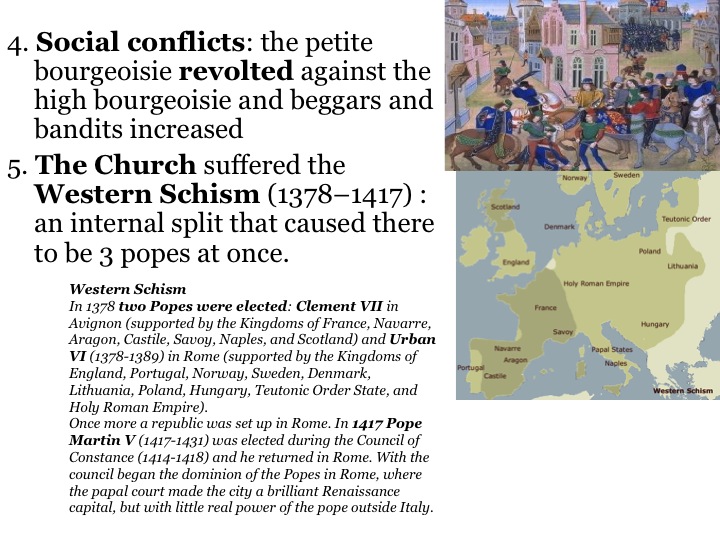
4. Social conflicts: the petite bourgeoisie revolted against the high bourgeoisie and beggars and bandits increased
5. The Church suffered the Western Schisms: an internal split that caused there to be 3 popes at once.

Recovery:
1.Good harvests helped the population increase.
2. Some kings managed to assert their power over the nobility and high bourgeoisie.
3. Humanism developed among scholars and leaders.
4. Gutenberg invented the printing press, making books cheaper and more available.
5. Innovations in navigation brought new geographical discoveries.
6. At the end of the 15th century: Medieval Society à Early Modern Age

CCSS3 Unit 3: Population


CCSS3 Unit 3: Population 
Part 1: Evolution + Distribution of Global Population p.46

-World pop. = 6 Billion (6,000,000,000); est. 12 Billion by year 2100
-Population growth varied:
1. Slow til 19th century
2. Faster after 19th c. b/c of sanitation/healthcare
3. Post mid-20th c. lower in richer countries, still high in poor countries

-Population Density= relationship between population + size of place
- divide # of inhabitants by total land area: express as inhabitants/km2
-uneven b/c of:
1.physical factors
-geography
-weather
            2. human factors
                        -job opportunities
                        -politcal (in)stability

Part 2: Natural Population Change p.48
can increase/decrease in pop. b/c of biological factors (birth, death)
1. Natality: Birth rate
BR = (births / total population) x 1000

            -divide total births in area per year by total population; multiply by 1000
            -expressed as per thousand
2. Mortality: Death rate
DR = (deaths / total population) x 1000

-       same as birthrate, but with deaths
-       expressed as per thousand
3. Natural Increase (NI) = number of births minus number of deaths
Ex: in the U.S.A in 2008 4,248,000 babies were born and 2,473,000 people died, so:
NI = 4,248,000 – 2,473,000 = 1,775,000


4.Rate of Natural Increase (RNI) = the rate at which the population is growing (expressed as a percent)
You can find it 2 different ways:
RNI = (BR-DR)/10
or
RNI = ((#of births - # of deaths)/ total population) x 1000

Part 3: Population Movement p.50

Regular Population Movements
            1. Commuting – for work/study
            2. Free time/Leisure – holidays
Migration – change residence + job
            -internal = same country
-external = another one
-emigration (from)
-immigration (t0)

Part 4: Population Structure
-Classifying populations based on:
            AGE: 3 age groups:
                        -young (0-14)
                        -adults (15-64)
                        -elderly (65+)
            SEX: more boys born but girls live longer
            ECONOMIC ACTIVITY: distinguish between:
                        -active population: ppl. of working age, employed + unemployed
                        -inactive population: ppl. who can’t work (minors, retired) or those not looking for jobs (stay-at-home parents)

Part 5: The Population of Spain p.52
-46million + people
-average pop. density = 91.22 ppl/km2

5.1 Population Distribution
-Pop. = unevenly distributed across Spain:

1. Densely populated areas:
-Madrid
-Iberian Penn. Periphery
-both archipelagos
-Provinces w/ 350+ ppl/km2:
            Madrid
            Barcelona
            Vizcaya
            Guipúzcoa

2. Low density areas:
-interior of Peninsula
-Provinces w/ lowest pop.density (<10 ppl/km2):
                  Soria
            Teruel

3. Within provinces:
-higher density in capitals/important cities
-mountain/farmland/weak economic areas = almost uninhabited

5.2 Natural Population Change p.53

  1. Birth Rate (Natality) = # of births in a population over a year (expressed out of 1000)
BR = (births / total population) x 1000
  1. Death Rate (Mortality) = # of deaths in the population over a year (expressed out of 1000)
DR = (deaths / total population) x 1000
  1. Natural Increase = # of births minus the # of deaths (expressed as a percent)
NI = ((BR – DR)/ total population) x 100


-Post 1980 drop in BR (9.1% 1998) b/c of:
            -Ppl. marrying later
            -women working
            -single person homes + single parents have increased
-Post 2000 BR has increased (now 11.38%) b/c of:
            -immigration
-DR low (8.47%)
-Infant Mortality Rate low (3.54%)
-RNI:
1980: .75%
1998: .01%
1999- started to rise b/c of rising BR
today: very low = .29%

5.3 Migration p.54
Internal Migration in Spain
1. Rural exodus is at a minimum
2. lots of ppl. have moved to satellite towns outside big cities
3. Retirees gone to coast
Foreign Immigrants
-High in number
-European: Romania, Bulgaria
-Africa: Morocco, Algeria
-go to Cataluña, Comunidad de Madrid, Comunitat Valenciana, Andalucía + Illes Balears

5.4 Population Structure
-by sex : normal
-by age: aging (elderly increasing)
-labor force: 59.8%
-unemployment: very high (esp. women + young ppl.)

Friday, November 16, 2012

CCSS 3º Global Exam Review – Minimum Contents


Unit 1
Latitude
Longitude
Time Zones: why they exist, how they’re measured, how to calculate hours between
Layers of the Earth
The Earth´s Relief (Continental and Oceanic)
-Part 8: Continents p.22: Identify: Oceans: all
Seas: Caribbean, Mediterranean, Coral, North, Red, Black, Caspian, Arabian,
Mountains: Ural, Atlas, Alps, Apennines, Caucasus, Himalayas, Andes, Rocky Mountains
Islands: British Isles, New Zealand, Falkland Islands, Japanese Archipelago, Iceland, Cyprus, Taiwan, Philippines, Sri Lanka, Tasmania
Rivers: Amazon, Mississippi, Rhine, Nile, Danube, Hwang-Ho, Yangtze
Peninsulas: Korean, Indochinese, Californian, Anatolian, Scandinavian, Yucatán
AND: Cape of Good Hope, Magellan Straight, Cook Straight, Bering Straight, Bay of Bengal, Hudson Bay, Persian Gulf

Unit 10
-Democratic States: characteristics (p.166)
-Vocabulary (p.166-169 and power point): national sovereignty, suffrage, head of state, monarchy, judicial power, legislative power, executive power, referendum, bill, statute of autonomy, court of audit, communities of chartered regime, parliamentary monarchy, motion of censure, state ombudsperson
-Freedoms of individuals: of assembly, of association, of expression, to private property, to life, to education (p.170 and 168)
-Roles and Compositions of Congress of Deputies, Senate and Government (p.168-9)


Unit 2
-geographical location of the Kingdom of Spain
-“plazas de soberanía”
-IDENTIFY ON A MAP: The Meseta , The Sistema Central, The Montes de Toledo, the Macizo Galaico-Leonés Mountains, the Cordillera Cantábrica,  the Sistema Ibérico, the Sierra Morena, the Ebro Depression, The Guadalquivir Depression, the Montes Vascos, the Cordilleras Costero-Catalanas, the Sistemas Béticos (Cordilleras Subbética and Penibetica).
AND: RIVERS: Ebro, Nervión, Tambre, Guadalquivir, Tajo, Miño, Guadiana, Júcar, Llobregat, Ter (p.34)
-Chart of Spain’s Climate Types (top of p.36)